


Discover some essential films on the theme of bodybuilding. Documentaries or fiction; a great way to explore this world.
We have all been marked by a filmed performance by’Arnold Schwarzenegger, for better or for worse. How can one not be affected by his impressive physique, whether to admire it or to loathe it? While it's common for bodybuilders to appear in movies playing tough guys, few films place bodybuilding at the heart of the story. Here, we offer a presentation of some films in which this sport plays an important, even central, role. You'll find documentaries, action films, social or romantic dramas. The list is by no means exhaustive, but rather presents the different ways in which bodybuilding has been portrayed on the big screen. The most motivated and adventurous among you can tackle "I" (trailer), an Indian film released in 2015. Be warned, this is pure Bollywood: three and a half hours of film, songs, a spectacle, and… questionable special effects. For everyone else, start with the four films listed below; you'll already get a decent idea of what cinema has produced in terms of muscular physiques.
Pumping Iron
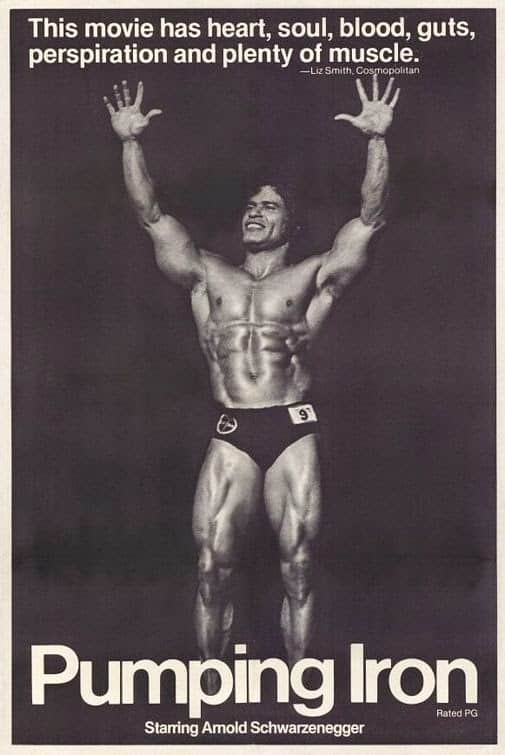 Pumping Iron, released in 1977, is a documentary film that chronicles Arnold Schwarzenegger's preparation for and participation in the competition Mister Olympia From 1975. At the time of filming, he already had a seasoned career behind him, having won the title five times, and when he speaks to the camera during the numerous interviews, we discover a professional driven by boundless passion. The documentary pays a beautiful tribute to bodybuilding as both a sport and an aesthetic discipline. The opening scene is particularly eloquent in this regard: rather than weights and other weightlifting equipment, it is a dance studio that introduces the character. Two bodybuilders, a ballerina—the contrast is striking, their biceps being much thicker than her thighs… But the objective is the same: «The judges aren’t just watching you when you hold a pose, they’re watching you constantly.» Hence the focus on eye contact, the slowness and elegance of movement between poses. In the training room, there’s a time for pumping, and a time when the five-time Mr. Universe corrects the poses of the younger competitors. With his gaze higher, his arm straighter, his chest more assertive, and so on, once on stage, Schwarzenegger eclipses his competitors, displaying his physique with such confidence and brilliance. This confidence stems from his training and exemplary determination. Mental preparation is a crucial component of his success. His competitor in the heavyweight division, Lou Ferrigno, demonstrates this by contrast. Young, constantly supported by his father, both ambitious and intimidated by his opponent's stature, he lacks Schwarzenegger's ease and enjoyment on stage. Unsurprisingly, Schwarzenegger wins the title once again before ending his professional bodybuilding career. Ultimately, Pumping Iron is nothing more than an excellent documentary about the preparation for an international sporting competition by a top-level athlete… with a lot of muscle.
Pain & Gain
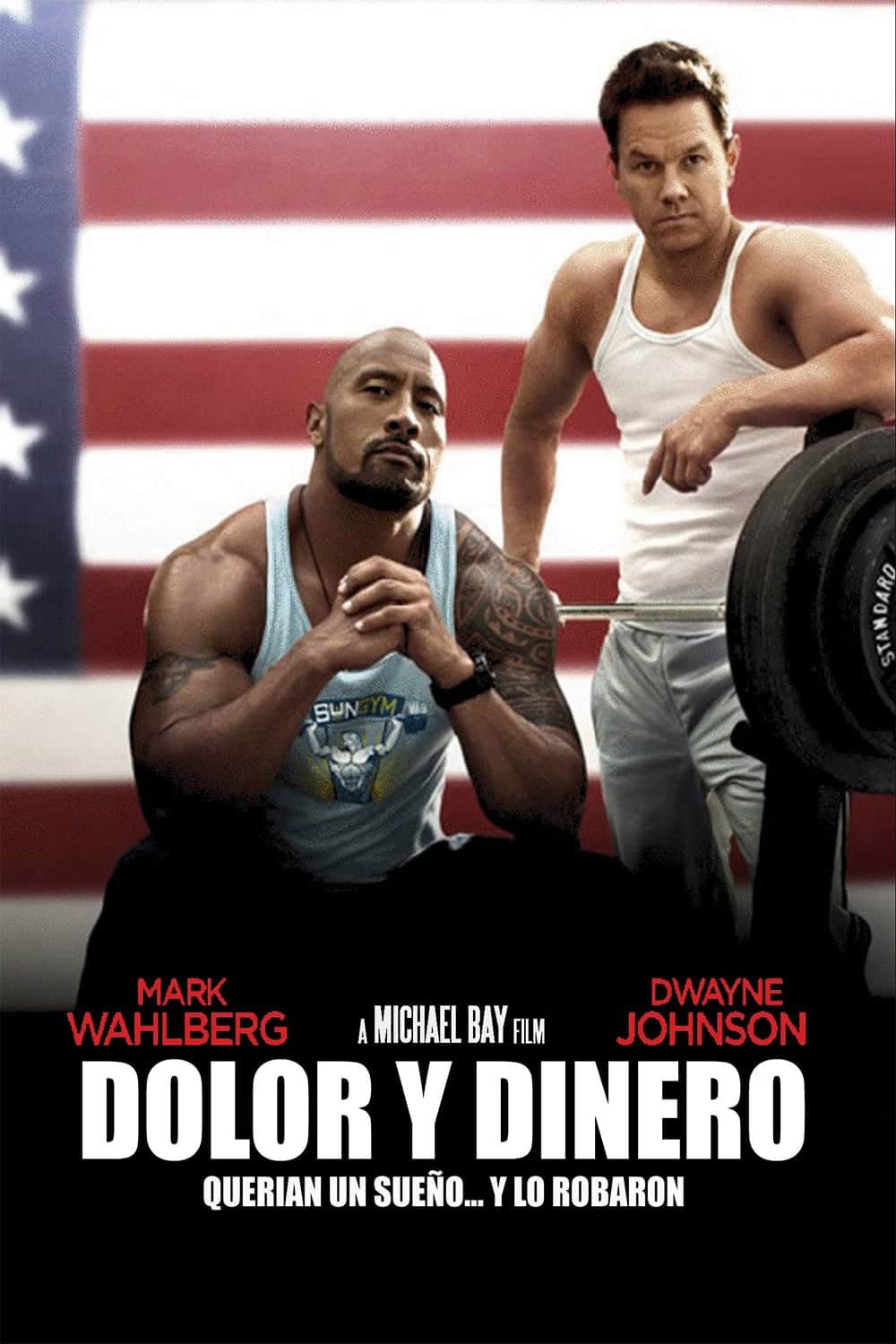
Pain & Gain (No Pain, No Gain in French) is a 2013 action-comedy film starring Dwayne Johnson, Mark Wahlberg, and Anthony Mackie, inspired by a true story. Here, bodybuilding is not portrayed in a flattering light. Let's not mince words: the entire film hinges on the fact that the three main characters, bodybuilders, are complete idiots. "Muscles instead of brains"—that's the tone of this comedy, best enjoyed with a healthy dose of irony. Daniel Lugo (Mark Wahlberg), the self-proclaimed mastermind of the group, is a man with both boundless and utterly simple ambition: he wants to live the American dream, to fulfill his desire to become "a monument of physical perfection," to become someone. His brilliant plan, hatched after attending a farcical lecture on self-improvement and entrepreneurship, involves kidnapping a wealthy client from his gym and extorting his fortune. When his partners question the viability of the project, his response reflects his sharp mind: "I've seen loads of movies, I know how it works." Alongside him is an even less enlightened friend, ready to do anything to also become someone—namely, to be rich and find a wife despite his erectile dysfunction—and another bodybuilder recently released from prison who has taken refuge in the Christian faith. The latter is surely the most endearing character in the film: Dwayne "The Rock" Johnson perfectly embodies the image of a big, violent guy with rather convincing threats, but one to whom we become attached because he doesn't really know why he does what he does, lost between the dictates of his faith, his partner, and his cocaine addiction. There's a certain pleasure in watching these three naive athletes, overwhelmed by events, accidentally kill their peers, lift weights amidst a bloodbath to unwind, and finally, in public—the story still being true at this point—barbecue human limbs to dispose of the evidence. It's a lighthearted film, then, where the characters' desire for physical perfection ultimately morphs into a lust for wealth, and where the physical exertion of bodybuilding becomes the tool for carrying out illegal, murderous, and particularly chaotic operations. This film isn't for its portrayal of bodybuilding, but certainly for the action, the humor, and the characters' intelligence.
Bodybuilder
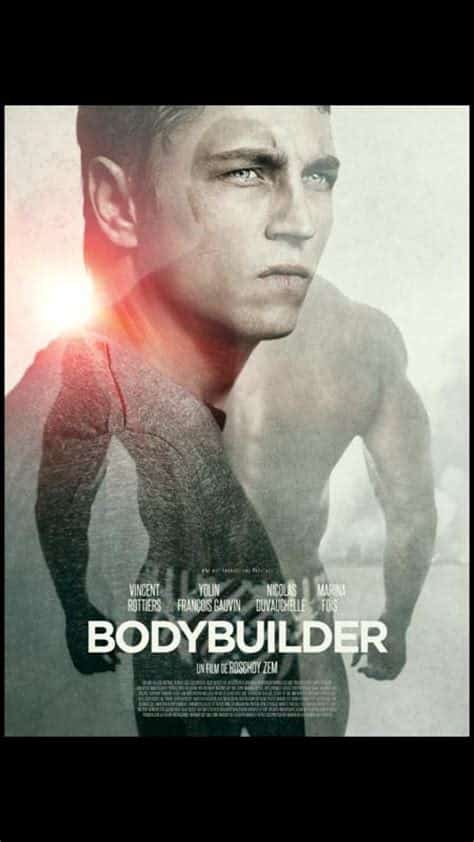 Bodybuilder is a French film released in 2014, directed by Roschdy Zem. It falls into the category of social and family drama, following the journey of Antoine, a young man in his twenties, involved in a loan deal that leads to him being harassed by some rather nasty delinquents. He is sent to live with his father in Saint-Étienne, where his mother hopes he will be both protected and sufficiently isolated to resume a normal life. He hasn't seen his father in years and has very few memories of him. At fifty-eight, his father is the local star bodybuilder, owner of a gym, and entirely dedicated to his sport. The film opens with a clip from Pumping Iron, where Schwarzenegger explains how he detaches himself from everything else as a competition approaches, where the only thing that matters is his physical and mental preparation. This is ultimately the central thread of the story, as the relationship between father and son is constantly shaped by the father's training regimen, the strict dietary discipline he adheres to, and the friction caused by his son's presence, a complete outsider to this world. While we quickly understand that, for Antoine, this sojourn in a disciplined and passionate world will serve as a form of redemption, the film avoids the cliché scenario where the son takes up bodybuilding like his father and finds a path to emancipation. Instead, he observes his father with amusement, stealing some of his supplements, trying on his stage briefs in front of a mirror, exaggerating muscles he doesn't have. "Damn, that's my dad!" The expected discovery-crisis-reconciliation pattern is present, but the overall execution is quite good, without being extraordinary. The son eventually comes to understand the pleasure his father finds in bodybuilding, while the father rediscovers his affection for his son. The film emphasizes the demanding nature of the discipline: diet, very frequent training, solitude, and so on. This will ultimately be the last competition for this veteran bodybuilder, a bitter defeat which, combined with the arrival of his son, pushes him to quit. "It's too hard." One memorable moment, however, is the confrontation between the delinquents chasing Antoine and about twenty bodybuilders in a small laundromat. No fight breaks out, just threats, but the situation is comical. "It's just muscle-building; in three months, if I want, I can be like them," the owner of the place blurts out. This is the crux of the film: bodybuilding is presented as a misunderstood, ridiculed, and little-known world, which we gradually enter, ultimately seeing it differently and appreciating it for what it truly is. Definitely not muscle pumps.
Teddy Bear
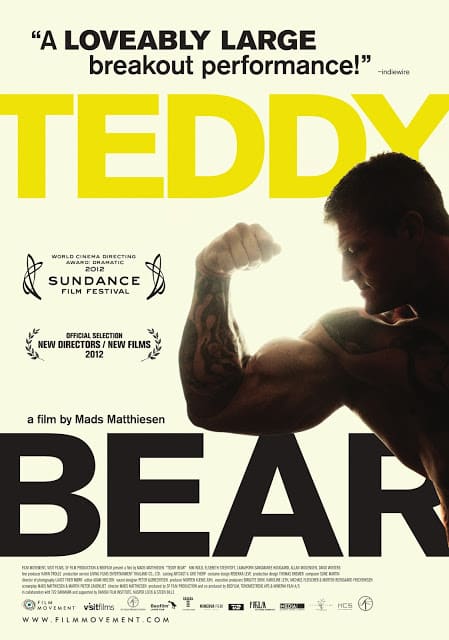 Teddy Bear is a Danish film released in 2012, starring Kim Kold. Dennis, a professional bodybuilder in his forties, living alone with his overbearing mother, decides to travel to Thailand on the advice of his uncle, recently married to a Thai woman he met there. Immediately immersed in the world of sex tourism, his discomfort is palpable, and the arranged encounters are a failure. The film's title then takes on its full meaning: a man of gigantic proportions, perceived as a tough guy, who hides a particularly tender personality, who doesn't dare say no to anyone, and who does everything to disappear. Of all the actors featured in the films presented here, Kim Kold is surely the most impressive. Tall, with a hard, square face and a prominent tattoo on his torso, his physical presence is as important to the role as his acting. It is ultimately through a man he meets at the local gym that Dennis finds love, a simple and shy love, much like his character, which his mother struggles to accept. The direction is simple and effective, without sentimental excess, romantic dialogue, or exaggeration. Here, bodybuilding represents the negative, the cause of this physical shell that prevents the person from expressing themselves. Ultimately, it's less a love story than the coming-of-age journey of a man struggling with his inner life.
Conclusion
If there's one common thread running through all these approaches to bodybuilding, it's self-improvement. While it's purely competitive in Pumping Iron, it takes on more psychological forms in the other films. Personal success, family life, emancipation… The culture of the body, the discipline and effort it demands, are the visible part of this work on oneself. We expect the treatment of this subject to be less profound in a film like Pain & Gain than in Teddy Bear, for example, but the interest is the same. If you're looking for a film that focuses on bodybuilding specifically, Pumping Iron is a classic, and among more recent ones, we recommend Generation Iron (trailer) or even Bigger Stronger Faster (trailerApart from these documentary films, the other productions focus more on the bodybuilder as a person, and the link between his sporting practice and his social existence.
Contrary to critics who see it as nothing more than "bulking up," it's clear that the activity goes far beyond that. It's a complete investment of body and mind, where, ultimately, rather than strength, it's personality that is imprinted in the muscles.
Leave a Reply
You must be logged in to post a comment.