


Pushing oneself to the limit, reaching one's limits, are the driving forces of every fighter. Exceeding one's limits belongs to the realm of achievement and is unfortunately inevitable.
This body, which is first and foremost a machine, cannot transcend its genetic code. The barriers are numerous, and only the mind can make the difference.
Many foods called fortifying agents are necessary for the proper functioning of our body, and it is essential to consume them daily over a long period.
This process is long and without direct effect.
A bodybuilder is not like other athletes. Their entire muscular structure is utilized. Every part of their physique is stimulated. The effort is therefore more intense and requires a higher than normal nutritional intake.
The bodybuilder remains unique. The work he puts in is meticulously calculated and demands extreme discipline. This precision requires constant, daily concentration.
The metabolism is therefore constantly being used, even during sleep.
The bodybuilder's body is in a state of flux: calories are burned on a large scale and the body is in excessive demand for nutrients.
Many alternatives are available on the market. Regular consumption of these products It affects the biological balance of our body and leads to deficiency consequences in most cases.
Therefore, it is essential to modify its eating habits to benefit from the contributions of these alternatives.
This is why, thanks to scientific research and animal testing, a new generation of cutting-edge products has revolutionized the world of sports. Many negative perceptions surround this phenomenon, and unfounded rumors have quickly spread, without any attempt at verification.
The word "« doping »This statement is in itself a guilt-inducing criticism that pushes athletes to hide without considering therapy. These products meet a strong demand for physical support among athletes and bodybuilders.
Of course, like everything else, there are uncontrollable excesses due to recklessness and lack of precaution.
Myostatin
Even in ancient times, athletes used mixtures of plants, also called "explosive cocktails," which allowed them to reach superhuman levels.
Nowadays, microscopy reveals the secrets of the molecules contained in our bodies.
In particular, Myostatin, this protein limits the growth of muscle tissue so that the muscles do not become oversized and give us the physical appearance that we call "the norm".
Each individual is unique in their person and physique.
Nowadays, homogeneity reigns supreme and everyone wants to look like everyone else (fashion trend, hyper-consumption…)
But oversized muscles are necessary for any athlete wishing to increase their performance while maintaining strength and intensive training.

During physical preparation or during competition, and even during recovery, Myostatin, a molecule naturally secreted by skeletal muscle cells during body development and adulthood, controls muscle repair and growth by blocking muscle cell proliferation.
Let's look at a concrete example. When an athlete has a muscle tear or is following an intensive muscle strengthening program, the healing of the damaged muscle involves the activation of skeletal cells by Myostatin.
Muscle growth is controlled by a tear in the muscle which generates an inflation represented by a cell rupture which releases molecules.
Then comes a cascade of signals involving satellite cells, triggering the multiplication and development of new muscle fibers that are larger and stronger. Myostatin therefore regulates the size of muscle fibers but not their number.
This process continues until the muscle receives a signal to stop its growth.
Therefore, myostatin prevents the activation of satellite cells, thus halting muscle growth. It's important to note that this phenomenon only affects skeletal cells, and therefore cardiac muscle is not subject to this mechanism.
This is why the inhibition of Myostatin becomes necessary and beneficial to achieve its goal of muscle strength expansion.
How and why inhibit Myostatin?
Several methods are possible with the aim of preventing the binding between Myostatin and its receptor called activin IIB (ActRIIB). .
Through these methods, the activity of Myostatin will be blocked and muscle growth will not be stopped.

Follistatin and ACE-031
The methods involve trapping active Myostatin using antibodies.
Or to inactivate it with a synthetic pro-peptide. Or to increase the expression of natural inhibitors of Myostatin such as Follistatin.
Or finally, to inactivate the Myostatin receptors attached to skeletal cells.
The molecules used can be endogenous or exogenous. Endogenous molecules play a role in modulating the activity of Myostatin.
These molecules are called, among other things, Follistatin.
Follistatin is a peptide present in human serum; it naturally inhibits myostatin.
This molecule binds to circulating Myostatin in the serum and prevents its binding to the receptor.
It sequesters it at the level of the extracellular membrane, so Myostatin does not reach other cells.
Follistatin is synthesized in gonadotropic cells but also in folliculostellate cells in the anterior pituitary gland.
But it is also produced in other types of cells.
Its inhibitory role affects the amount of Myostatin that can bind to the activin receptor.
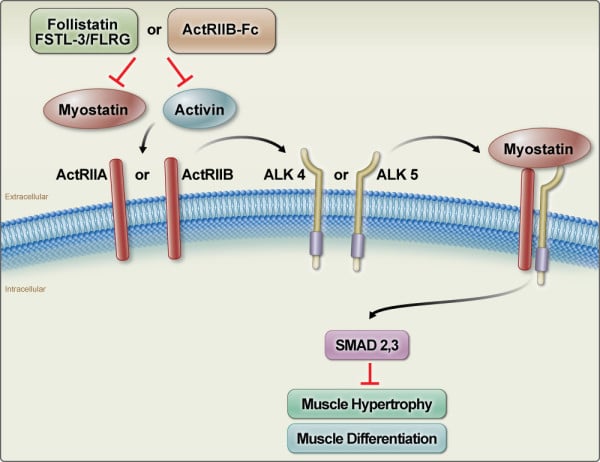
On the other hand, there is also the pro-peptide protein ACE-031 (ACVR2B), a synthetic molecule produced by linking a part of the receptor to a part of the human antibody.
This method blocks Myostatin receptors by directing antibodies against them.
The synthetic propeptide ACE-031 (ACVR2B) inactivates myostatin by binding to it. The propeptide then detaches from the inactive myostatin, which binds to the skeletal muscle cell via its receptor. With myostatin inactive, it no longer restricts muscle growth.
Cases of hypertrophy related to Myostatin.
As explained previously, myostatin has a regulatory effect on muscle mass. However, in the 1990s, a mutation of myostatin was discovered that disrupts the metabolism of animals, particularly cattle. This mutation, known as "blue-white-beige," does not stop muscle growth, and the animal's muscle mass increases considerably. This phenomenon, called hypertrophy, has detrimental consequences for their health, resulting in low collagen levels, a high proportion of fast-acting glycolytic fibers, and little fat deposition. Consequently, the animals are fatigued, more susceptible to respiratory diseases, have reduced fertility, and experience difficult calving.
However, a truly astonishing case was recently discovered in a three-year-old child. Liam Hoeksra, a German living in America, is a child like any other, except that since his earliest months he has been capable of incredible feats. These include lifting weights that weigh a third of his body weight and performing a series of abdominal crunches at lightning speed, among other things.
This child, who carries a very rare genetic mutation that affects his receptivity to Myostatin, has a 40% muscle mass greater than normal.
Unlike in animals, the hypertrophy Liam experiences has no adverse health consequences. In fact, Liam has a fast metabolism, low body fat, and extraordinary strength—everything a top athlete could dream of. Great hope rests on this child for the potential use of myostatin blockers.
Myostatin Clinical Studies
Although this case remains extremely rare, substantial clinical studies on myostatin are currently being conducted on animals and humans. However, studies have already been published on muscle function in the absence of myostatin.
Experiments conducted on myostatin-deficient mice reveal that, despite larger muscles, maximum strength is not increased and may even be decreased. It has been confirmed that animals with a myostatin deficiency lose oxidative fibers in favor of glycolytic fibers.
However, the effect of this fiber conversion on muscle function and exercise capacity is unknown. This is why laboratories are studying the possibility of reversing this process through specific muscle exercises.
All studies have observed an increase in muscle mass following myostatin blockade. Increases in force production have also been calculated. These results are promising and support the potential of myostatin blockade therapy.
Moreover, this effect is not only beneficial to muscle growth but also results in complex interactions with other tissues, allowing for the improvement of muscle architecture.
On the other hand, blocking Myostatin has therapeutic benefits for many muscular diseases such as Duchenne muscular dystrophy.
It has also been proven that deactivating myostatin has a direct impact on cancer cells, allowing for a longer lifespan in patients, particularly those with colon cancer.
Conclusion: Will studies on Myostatin turn us into superhumans?
From studies of Myostatin we can be certain that it is a mutant molecule capable of modifying itself in order to double the capacity of the muscular system.
Have we been genetically modified as humanity has progressed? Has our genetic code evolved to the point where the strength of our brain has replaced the strength of our muscles?
Many questions remain unanswered, such as the construction of the Egyptian pyramids on desert soil by human power alone.
Has our body adapted to our living conditions?
Genetics is already at the forefront. The scientific world is in a state of flux, and highly improbable experiments are emerging thanks to modern technology.
A promising future encompasses this phenomenon of modifiable myostatin. Modern technology will increasingly advance, allowing science to unravel the mysteries of our bodies over time. Will humanity's future be inspired by fiction? Will the heroes of our childhood be the people of tomorrow? Anything is possible. But what is certain is that the human body has an infinite capacity for adaptation. Life expectancy has increased over the last few centuries. The diversity of food, thanks to globalization, predisposes us to a better understanding of nutrition. The medical community shares its research and knowledge internationally. And the comfort of our lives makes it easier for us to take better care of our bodies.
Nowadays, large megacities prioritize individualism. "One for all, all for one" has completely vanished. "Every man for himself" has taken its place.
A paradoxical social life, where excessive density blends with solitary existences, and where the neighbor has become invisible even as we communicate across miles via the internet. A modern life that moves at breakneck speed, dividing us and rendering us strangers face to face.
This intensifies a feeling of insecurity and encourages precautionary measures.
A world where the law of the strongest is in operation.
Will the law of the jungle reign in the world of tomorrow? Perhaps, but this abstraction of the group should awaken us in order to take precautions.
What better security than knowing you can rely on yourself? Beyond material possessions (house, car, money), this feeling of self-satisfaction and increased self-confidence can only be acquired through mastery of one's body and mind.
The athlete already stands out and distinguishes him from the crowd. His fighting spirit sets him apart, and pushing himself to the limit is a solid and indestructible routine.
He is aware of the world he lives in and finds it difficult to trust others. This individual will naturally seek to develop his physical and mental strength, to become increasingly powerful.
Your blog is a wellspring of knowledge
The article is a bit long and a bit too technical, but so captivating in the end because it's so well explained.